Compliance Automation Software - Full Comparison (2026)
Four platforms dominate compliance automation for ISO 27001, SOC 2, and PCI DSS. All four automate evidence collection, continuous monitoring, and audit readiness. The differences are in integration depth, support model, speed of implementation, and pricing structure.
This page compares all four head-to-head across features, pricing, framework coverage, integrations, and who should pick each one.
Vanta
Drata
Secureframe
Sprinto
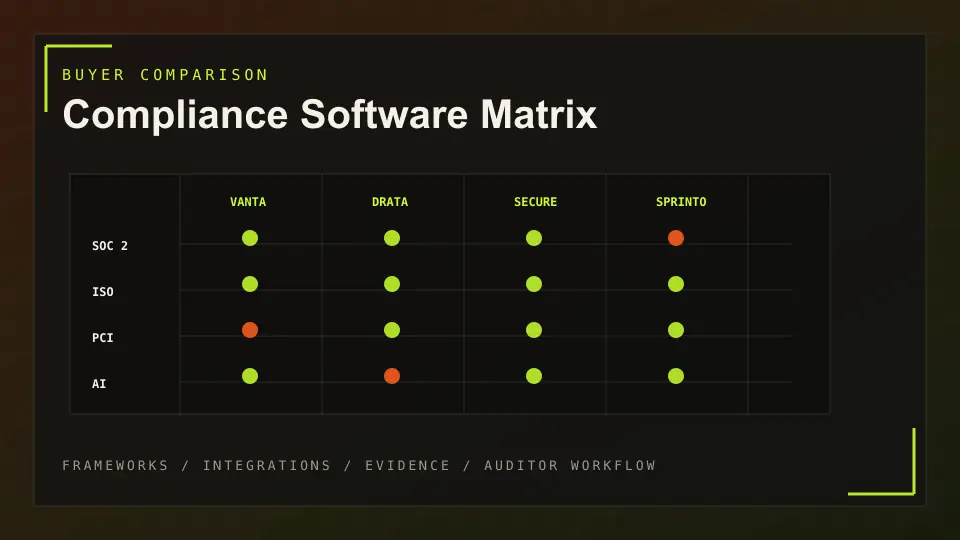
Vanta
Drata
Secureframe
Sprinto
Swipe sideways to compare columns
Know the controls, evidence owners, and policy gaps first.
Compliance software is easier to evaluate when you know which framework comes first, which policies are missing, and which systems need automated evidence collection.
Map controls to policies
Open the policy template that matches access, data, suppliers, incidents, development, backups, endpoints, cryptography or AI governance.
2Choose the first framework
Confirm whether SOC 2, ISO 27001, PCI DSS or ISO 42001 is the actual buyer or assessor demand.
3Shortlist platforms
Compare Vanta, Drata, Secureframe and Sprinto against evidence owners, integrations, support and budget.
Detailed Reviews
Vanta is the market-leading compliance automation platform.
It automates the grunt work of compliance, continuously pulling evidence from your cloud, identity, and HR systems and mapping it to the controls each framework requires.
It is a common first pick for companies pursuing ISO 27001 or SOC 2, and it covers PCI DSS too.
Vanta prepares you for an audit; the certificate itself comes from an accredited certification body or QSA..
Pros
- + Largest integration library (100+)
- + Strong brand recognition among auditors and buyers
- + Trust Center that you can share with customers
- + Broad framework coverage
Cons
- - Pricing is opaque and can be steep for small teams
- - No free tier or trial
- - Self-serve onboarding means less hand-holding
Best for: Teams pursuing their first certification who want the broadest ecosystem and brand recognition
Drata is Vanta's closest rival, with continuous control monitoring, a large integration catalogue, and support for more than twenty frameworks.
Drata automates evidence collection and control testing across your entire tech stack, giving you real-time visibility into compliance posture.
Its monitoring engine is widely regarded as the most sophisticated in the category..
Pros
- + Deepest continuous monitoring engine in the market
- + Supports 20+ frameworks (the most)
- + Strong automated evidence collection
- + Excellent for multi-framework programs
Cons
- - Pricing is opaque and scales with headcount
- - No free tier or trial
- - Can feel complex for very small teams
Best for: Teams that need deep continuous monitoring across many frameworks at scale
Secureframe leans into guided, supported onboarding, which suits teams tackling their first certification and wanting a human to lean on.
The platform covers SOC 2, ISO 27001, PCI DSS, HIPAA, and GDPR, with a focus on making the compliance journey less painful through dedicated support and a structured playbook..
Pros
- + Guided onboarding with dedicated support
- + Clean, user-friendly interface
- + Strong training and resource library
- + Good value for early-stage companies
Cons
- - Smaller integration library than Vanta or Drata
- - Less automated monitoring depth
- - Fewer frameworks than Drata
Best for: First-time compliance teams who want more guidance and hands-on support
Sprinto targets cloud-first SMBs with a faster, lighter implementation and competitive pricing.
It covers SOC 2, ISO 27001, PCI DSS, HIPAA, GDPR, and SOC 3, with a focus on speed and affordability for startups and mid-market companies.
Sprinto's cloud-native approach means faster setup and lower overhead than the enterprise-heavy options..
Pros
- + Fastest implementation for cloud stacks
- + Competitive pricing for SMBs
- + Clean, modern interface
- + Good framework coverage for the price
Cons
- - Fewer enterprise features
- - Newer brand than Vanta or Drata
- - Smaller integration library
Best for: Cloud-native SMBs and startups that want the fastest, most affordable route to certification
Feature Comparison Matrix
Vanta
Drata
Secureframe
Sprinto
Swipe sideways to compare columns
Pricing Comparison
Vanta
Drata
Secureframe
Sprinto
Swipe sideways to compare columns
Framework Coverage
Vanta
Drata
Secureframe
Sprinto
Swipe sideways to compare columns
Integration Ecosystem
Vanta
Drata
Secureframe
Sprinto
Swipe sideways to compare columns
Decision Guide
Choose Vanta if you want the broadest ecosystem and brand recognition with auditors and buyers
Choose Drata if you need the deepest continuous monitoring and support 20+ frameworks from day one
Choose Secureframe if you are a first-time compliance team that wants guided, hands-on support through the process
Choose Sprinto if you are a cloud-native SMB that wants the fastest, leanest path to audit readiness
Get quotes from at least two vendors before committing
Verdict
All four platforms can get you audit-ready and support certification workflows where a framework uses certificates. Vanta is the safest bet for teams that want the broadest ecosystem and brand trust. Drata is the choice for teams that need deep, continuous monitoring across many frameworks. Secureframe is best for first-time teams that want a guiding hand. Sprinto is the fastest and most affordable option for cloud-native SMBs. Get quotes from at least two vendors and pick based on your team size, timeline, and framework needs.
Sponsored links. We may earn a commission at no extra cost to you.
Frequently Asked Questions
Which compliance software is best for a startup?
For most startups, Sprinto or Secureframe offer the best balance of speed, cost, and support. Sprinto is fastest for cloud-native stacks; Secureframe offers more guided support if you are new to compliance.
How long does it take to get compliant with one of these platforms?
Most teams reach first-audit readiness in 60-90 days with Vanta or Drata, and 30-60 days with Sprinto for cloud-native stacks. Secureframe typically runs 60-90 days with guided onboarding.
Do these platforms replace the need for an auditor?
No. These platforms automate evidence collection and monitoring, but you still need the right independent auditor, certification body, CPA firm, or QSA for the framework outcome.
Can I switch compliance platforms mid-certification?
It is possible but not ideal. Each platform requires its own evidence setup and integration configuration. Plan to commit to one platform for at least one audit cycle before switching.
Are the prices transparent?
None of the four platforms publish pricing publicly. All use custom quotes based on company size, headcount, and framework scope. Expect quotes starting around $3,000-5,000+/year for SMBs.
Which platform covers the most frameworks?
Drata covers 20+ frameworks, significantly more than the others. If you need multi-framework coverage (SOC 2, ISO 27001, PCI DSS, HIPAA, plus regional standards), Drata is the clear leader.